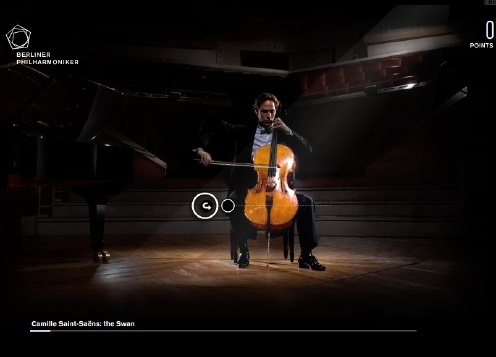
In this post I linked to the Berlin Phil’s Cello Challenge. Now, video game blog Kotaku has picked up on the game. Much to my delight, their readers (I am also one myself) were generally impressed with this simple little game, one even saying it could work with a full sized plastic cello, a la Rock Band. Many also commented about how they liked Saint-Saëns’ The Swan.
I guess classical music isn’t as nerdy as I thought.
I have been wanting to write this post for almost a week but it has required a lot of passive thinking-about, hence the lack of substantive posts in the meantime…
Two pops shows in two weeks has got me thinking about that particular series, part of virtually every not-big-5 orchestra’s season. Unlike the main series (often referred to as “Masterworks” or some other lofty catchword) a pops series can be harder to define. A cursive exploration of various orchestras’ pops series, however, reveals some common themes. Keep reading →
Sure there’s a limited number of ’songs,’ (1,) but this certainly has a better chance of engaging the masses and getting them interested in classical music than its closest competitor, the ill-fated Sousaphone Hero.
Playing injuries are an all too common in this line of work. A cornucopia of tendinitis, blown chops, and back problems are the most likely, but I have mastered injuring myself in a way that is surely unique to bass players… and possibly just to myself. Keep reading →
“For [a] conductor this is a question of how to use his personality and his education… the strength of his character… so that the musicians will be very quickly involved of the atmosphere of the piece. It doesn’t really matter how well you move with your hands. It should be in your face, it should be in your expression. “
-Valery Gergiev
This quote (which was from my last post ) came to mind as we rehearsed the Enigma Variations today.
I’ve been wondering recently about the importance of the physical part of what a conductor does. There are certainly many very renowned musicians with no formal training who are making careers out of conducting (or at least substantially supplementing their usual work with guest conducting.) In many cases these are chamber orchestras or baroque/classical music (often music composed at a time when the conductor as we know him today had yet to become a permanent fixture at the front of the orchestra.) Now I am ruling out poor musicians altogether. I want to know if a conductor can be successful relying on his or her musical mind, without any substantial training in the physical aspects of the task. Does there come a point when a great musician’s lack of training can actually be a detriment on the podium that cannot be overcome by a great musical mind, or even by just a deep passion for the music. Keep reading →
I don’t know much about this guy, but he’s Finnish and this could be the European Union Youth Orchestra… this has to be one of the most awesome videos I’ve seen (well, in the classical music sense anyway.)
The way the camera shakes (it’s sitting on a timpani head) and the way this fellow grins into the camera while he’s still delivering the hammer blow makes it my favourite Mahler 6 Hammer Strike video on YouTube. (Yes these things exist and there are more after the jump.) Keep reading →
The rebirth of this blog required a new theme. I like this one (Cutline) because it’s easy to read and looks suspiciously like a typical New York Times webpage, thus lending me a certain degree of suggested credibility. I promise a real post is coming. Look how pretty images look now!
Kind of, yes. I hope to give some sort of insiders perspective on the job of orchestral musician. The fact remains though, that even though I am entrenched in this business, I am still a fan or orchestras, (some might use the term nerd,) how they work and what they are capable of.